
 Skip to content
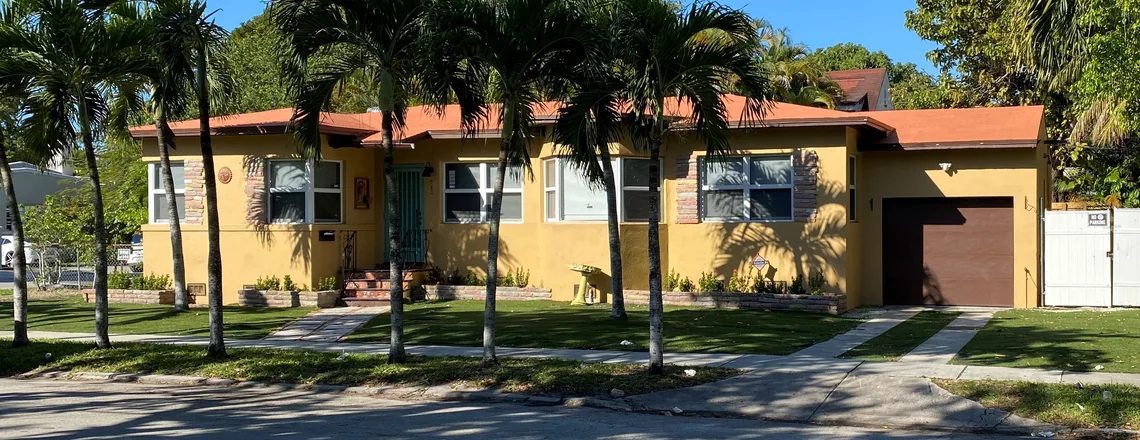
Most people who call us about a Miami-Dade house do not have a house problem. They have a gatekeeper problem. The house is fine, or fine enough, and then an insurance quote comes back at a number nobody expected, or a letter with a county seal lands in the mailbox, or a buyer’s lender asks a question about the roof and the deal that felt solid in week two quietly dies in week six. This guide is about those gatekeepers: what the recertification program actually covers, what Florida law says an insurer can and cannot do about your roof, what you have to tell a buyer about flooding, and what it costs you every month that the house sits while you figure it out.
You can sell a Miami-Dade house fast in 2026, and there are only two honest routes to it. Route one: price it for today’s market, make sure an insurer will write a policy on it, and accept that a financed buyer’s loan, appraisal and insurance quote will set your timeline. Route two: sell as-is to a cash buyer, where the offer arrives in about a day, no underwriter votes on the deal, and the closing lands in roughly two to three weeks once title is clear. Everything else is the slow route in a hurry’s clothing: testing a price “just to see”, waiting for rates to move, relisting after a deal collapses. The rest of this guide is about picking between the two real routes with the facts in front of you.
Here are the numbers rather than the mood. In September 2026, MIAMI REALTORS reported a median sale price of $692,000 for Miami-Dade single-family homes, up 4.06 percent from $665,000 a year earlier. Closed sales fell 4.7 percent, from 865 to 824. Active single-family listings dropped 16.6 percent, from 5,437 to 4,536, leaving 5.1 months of supply.
Read those together and you get a market that is tighter on inventory but slower on demand. Prices are still inching up, and fewer houses are changing hands. The timing numbers tell the real story for anyone in a hurry: a median of 41 days from listing to contract, a median of 80 days from listing to closing, and sellers receiving a median of 95 percent of the original asking price. That last figure is the one people skip. Half of Miami-Dade sellers cut their price by more than 5 percent before a contract stuck, and then waited about another five weeks for the closing.
So “list it and it will go” is true in Miami-Dade, as long as your definition of fast is around three months and your definition of your price is flexible. If either of those does not fit your situation, the gatekeepers below are what decide the rest.
This is the single most common misunderstanding we hear from Miami-Dade sellers, and clearing it up takes about a paragraph.
Miami-Dade County runs a building recertification program under Section 8-11(f) of the county code. It used to begin at 40 years, which is why people still call it the 40-year recert. In June 2022 the county moved the first recertification to 30 years, repeating every 10 years after that, and the county’s Board of Rules and Appeals rewrote its inspection guidelines in an October 2024 memo to line the program up with Florida’s own milestone inspections. Certain taller buildings near the coast recertify at 25 years instead.
None of that is aimed at a house. The county states plainly that single-family homes and duplexes are exempt, along with buildings carrying an occupant load of ten or less and two thousand square feet or less. The county’s own recertification notice repeats it word for word: those residences do not go through the recertification process.
The statewide program is just as narrow. Florida’s milestone inspection law, section 553.899, applies to buildings that are three habitable stories or more and subject to the condominium or cooperative form of ownership. A single-family house is outside it. We buy single-family houses only, so for our sellers this question comes up and then goes away.
If a recertification notice does arrive for your property, do not bin it. The county asks owners claiming an exemption to notify its office and send documentation, including dated photographs showing the front and rear of the building. The notice is generated from Property Appraiser records, and records can be wrong about what is standing on a folio.
Ignoring it is the expensive option. The county’s notice gives 90 days to file the report, sets the filing fee at $403.12, and warns that failure leads to a civil violation ticket and referral to the Unsafe Structures Unit, with a maximum fine of $10,510.00 and, at the far end, a building that must be vacated or demolished. A five minute phone call beats all of that.
Here is the chain that ends most financed Miami-Dade deals. A buyer with a mortgage must carry homeowners insurance. The insurer looks hardest at the roof, then at the wiring, the plumbing and the claims history. If no carrier will bind a policy at a price the buyer can live with, the buyer cannot close, no matter how much they love the house. The underwriter never meets you and never sees the listing, and they get a vote before the buyer does.
What surprises sellers is how much room Florida law actually gives an older roof. Under Florida Statute 627.7011, an insurer may not refuse to issue or renew a policy on a residential structure with a roof that is less than 15 years old solely because of the age of the roof. For a roof that is at least 15 years old, the insurer must allow the homeowner to have an inspection performed by an authorized inspector, at the homeowner’s expense, before requiring the roof to be replaced. If that inspection indicates the roof has five years or more of useful life remaining, the insurer may not refuse to issue or renew solely because of the roof’s age.
Read it carefully and you can see both the protection and the limit. Age alone is not a legal reason to say no. Condition still is. A 22 year old roof in sound shape has a path. A 12 year old roof with lifted shingles and two prior claims does not get rescued by the statute. If that is your situation, we wrote the long version here: selling a house that needs a new roof.
Two other pieces of Florida insurance law are worth knowing before you price anything. Mitigation pays: section 627.0629 requires residential rate filings to include actuarially reasonable discounts and credits for features that reduce windstorm loss, naming roof strength, roof covering performance, roof-to-wall strength, opening protection and window, door and skylight strength among them. If your house has shutters or a strapped roof and nobody has ever produced the wind mitigation paperwork, that is real money sitting on the table for whoever buys it. And the deductible your buyer is quoted will not be a flat number: under section 627.701, insurers must offer hurricane deductibles of $500, 2 percent, 5 percent and 10 percent of the dwelling limits, and that deductible applies on an annual basis to all covered hurricane losses in a calendar year.
The quiet rule of the Miami-Dade market: a house that no carrier wants to write is a cash-only house, whatever the listing says. Nothing on the MLS announces this. It shows up in week five of a financed deal, after you have already turned down other buyers.
If the premium itself is what is pushing you out of the house, this one is for you: selling when you can no longer afford Florida insurance.

The flood disclosure is a form you hand over, not a conversation you have later. Florida requires it by the time the contract is signed.
Florida added section 689.302 to the statutes in 2024, and it changed what a seller owes a buyer on paper. A seller must complete and provide a flood disclosure to a purchaser of residential real property, and it has to be given no later than the time the sales contract is signed.
The form asks two concrete things: whether you have filed a claim with an insurance provider relating to flood damage on the property, and whether you have received federal assistance for flood damage to the property. It also tells buyers in plain terms that homeowners policies generally do not include coverage for damage resulting from floods, which is the sentence a surprising number of buyers are reading for the first time.
Two things follow from this. First, disclosure is about what you know, not what you suspect. If you bought the house in 2019, you are not expected to narrate what happened to it in 1992. Second, and this is the part sellers get wrong in both directions: disclosing a problem is not the same as being required to fix it. You can sell a house with a flood history exactly as it stands. What becomes hard is selling that house to a buyer who needs a lender and a flood policy, because cost and underwriting will do their work late in the process. If a storm is the reason you are selling at all, the companion guide is here: selling a hurricane-damaged house as-is in Florida.

Florida property taxes run on a fixed calendar: payable in November, delinquent on April 1, certificate sold by June 1.
“We will wait and see” is a plan with a monthly invoice attached, and in Miami-Dade the invoice is bigger than most. While the house waits you keep paying the premium that is priced for South Florida risk, the taxes, the utilities, the lawn so code enforcement stays quiet, and, on a vacant house, a policy that may restrict coverage exactly when the house is least protected. Every June to November adds a storm season to the arithmetic.
The tax side runs on a calendar you can plan around. Under Florida Statute 197.333, taxes are due and payable on November 1 and become delinquent on April 1 of the following year. Paying early earns a discount under section 197.162: 4 percent in November, 3 percent in December, 2 percent in January, 1 percent in February and zero in March. Let them go delinquent and the tax collector must sell a tax certificate on the property on or before June 1, or the sixtieth day after delinquency, whichever is later.
A tax certificate is not the end of the world and it is not the loss of your house. It is a lien someone else now holds, earning interest, with its own long road toward a tax deed. The practical point for a seller is simpler: unpaid taxes get paid out of the proceeds at closing, as a line on the settlement statement. They are a reason to move, not a reason you cannot.
For a Miami-Dade owner who cares about speed and certainty, the real menu is short: