
 Skip to content

Say the dues were $240 a quarter. You missed one, then another, and now there is a letter from a law firm you have never heard of saying you owe $3,180 and that a claim of lien has been recorded against your house. That jump is the part nobody warns you about, and it is also the part Florida law spells out in more detail than almost anybody reads. Chapter 720 of the statutes governs homeowners’ associations, the kind that run ordinary single-family subdivisions, and it sets out the exact letters, the exact waiting periods and the exact order your money gets applied in. Here is that machinery in order, with what each step costs and what it does to a sale.
If you can clear it, clear it early, because the cheap part of this debt is the dues and the expensive part is everything that attaches to them once a lawyer opens a file. If you cannot clear it but you want to keep the house, ask the association in writing for a payment plan and get the answer in writing, and know that you have two statutory tools most owners never hear about: the notice of contest of lien and the qualifying offer. If the house needs work you cannot fund, or the dues were never going to fit the budget again, then sell while the decision is still yours. An HOA lien is a payoff line at closing, the same as a mortgage or back taxes. At a clerk’s foreclosure sale it is something else entirely.
Florida is association country. The Foundation for Community Association Research counts about 50,600 community associations in Florida covering roughly 4,473,000 housing units and 10,882,000 residents, out of roughly 373,000 associations nationally. Only California has more. Whether your house is one of them is not a guess: a declaration of covenants is recorded in the county’s official records against your parcel, and it is listed in the title policy you got at closing.
That declaration is where the power comes from. Under section 720.3085(1), when the governing documents authorise it, the association has a lien on each parcel to secure assessments, and that lien relates back to the date the original declaration of the community was recorded. As against a first mortgage of record, it is effective only from the day a claim of lien is recorded. In plain terms: the association’s claim is old, your lender’s claim is usually older, and the recording date is what sorts them out.
A claim of lien has to name the parcel, the record owner, the association and its address, the amount due and the due date. Once recorded, paragraph (1)(a) says it secures not only the unpaid assessments but everything that accrues afterwards up to the entry of a certificate of title, plus interest, late charges and the association’s reasonable costs and attorney fees. That is the sentence that turns $480 of missed dues into four figures.
Fines are a different animal. Under section 720.305(2) a fine may not exceed $100 per violation unless the governing documents say otherwise, daily fines for a continuing violation may not exceed $1,000 in the aggregate unless the documents say otherwise, and a fine of less than $1,000 may not become a lien against a parcel. The board also has to give at least 14 days’ written notice of your right to a hearing, and that hearing goes before a committee of at least three members who are not officers, directors or employees of the association or their close relatives. If somebody tells you a $75 mailbox fine put a lien on your house, ask to see the recorded document.
Three letters, in this order, and each one has a number on it.
Letter one: the notice of late assessment, 30 days. Paragraph (3)(d) of section 720.3085 says an association may not require payment of attorney fees related to a past due assessment without first delivering a written notice of late assessment that gives you a chance to pay without them. The statutory form says the amounts “must be paid within 30 days after the date of this letter.” It goes by first-class mail to your address in the association’s records and, if that is not the property address, to the property as well. This letter is your cheapest exit. Pay inside it and the lawyer never opens a file.
Letter two: the notice of intent to record a claim of lien, 45 days. Under subsection (4), the association may not record a lien at all unless it has made written demand first, and that demand must give the owner 45 days following the date the notice is deposited in the mail to pay everything due, including attorney fees and the actual costs of preparing and delivering the demand. Paragraph (4)(b) requires it to go by registered or certified mail, return receipt requested, and by first-class mail as well.
Letter three: the notice of intent to foreclose, 45 days. Subsection (5) is blunt. The action to foreclose may not be brought until 45 days after the owner has been given notice of the association’s intent to foreclose, that notice has to go out the same certified way, and it may not be provided until the 45 days in paragraph (4)(a) have passed. So from the first demand to a complaint on file is at least 90 days, and counting the late assessment notice it is closer to four months.
One exception worth knowing: paragraph (5)(b) says those time limits do not apply if the parcel is already subject to somebody else’s foreclosure or forced sale, or if an owner is a debtor in bankruptcy. If your mortgage lender is already foreclosing, the association can move with the case rather than behind it, and the mortgage clock is usually the shorter one. If that is your situation, read this next to selling before foreclosure in Florida.
Ask for the ledger, not the total. Florida law decides the order your payments are applied in, and the dues are last in that queue.
Put the layers in a row and the jump stops being mysterious.
That last rule is why partial payments can feel like shovelling sand. You pay $500, the dues balance barely moves, and the next quarter’s assessment lands on top. None of it is a trick. It is in the statute, in that order, and knowing it changes what you ask for when you call: a written payoff with the ledger behind it, not a round number over the phone.
The notice of contest of lien. Paragraph (1)(b) of section 720.3085 gives you a short recorded form that forces the association’s hand. Record it, the clerk mails a copy to the association by certified mail, and from the date of service the association has 90 days to file an action to enforce the lien. If it does not, the lien is void. The window stretches only for a bankruptcy stay. This is the tool for a lien you believe is wrong or inflated, and it is worth a lawyer’s hour before you use it, because forcing a suit you then lose is an expensive way to be right.
The qualifying offer. Subsection (6) is the one almost nobody has heard of. After you have been served in a lien foreclosure, and as long as the parcel is not also in a mortgage foreclosure or a tax certificate sale and you are not in bankruptcy, you may file one written offer with the court to pay everything the lien secures. Filing it stays the foreclosure for the period stated in the offer, which cannot exceed 60 days from service and must end at least 30 days before the trial date. While the stay runs, the association may not add its own legal fees to your bill. You get exactly one, it has to be signed by every owner and notarised, and breaking it lifts the stay. Used properly, it buys two months to close a sale or a refinance with the clock stopped.
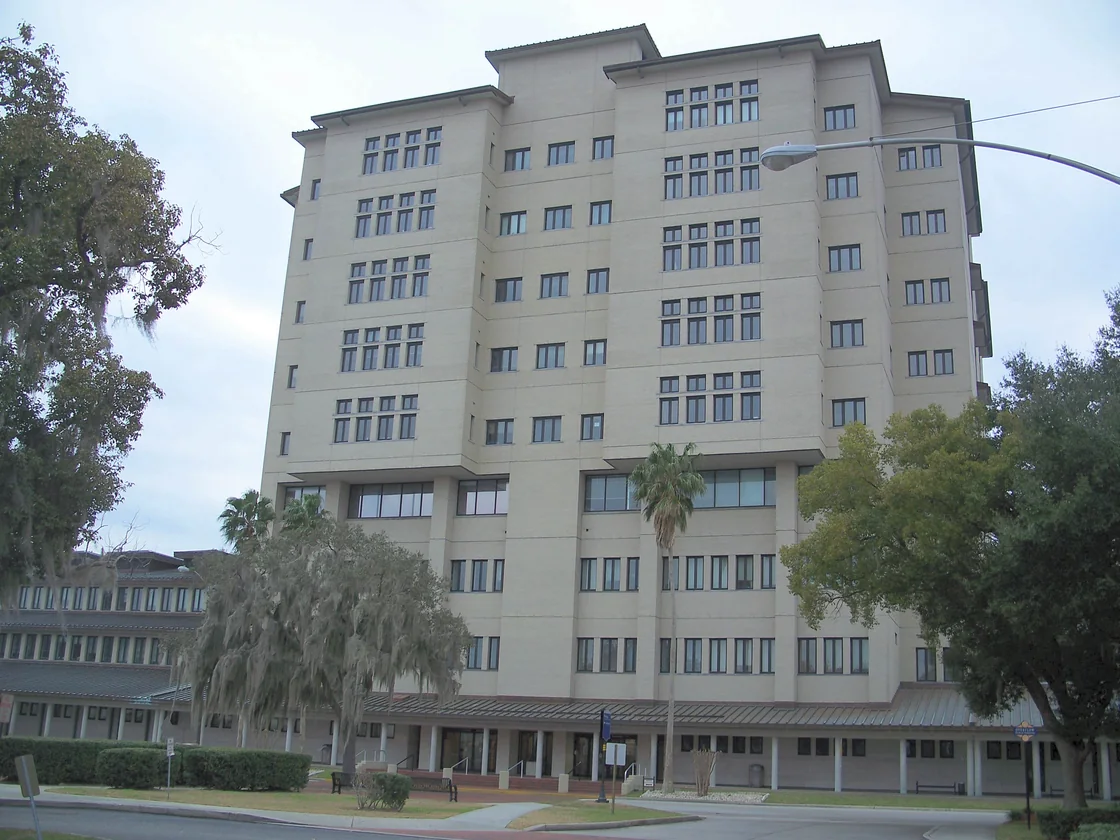
Polk County’s courthouse in Bartow. A Florida HOA cannot sell your house by letter. It has to come here first. Photo: Ebyabe, CC BY-SA 2.5, via Wikimedia Commons (cropped).
Paragraph (1)(c) says the association forecloses its lien in the same manner in which a mortgage of real property is foreclosed. Florida has no non-judicial shortcut for this. There is a complaint, a case number, a judge and a clerk.
The filing usually comes with a notice of lis pendens recorded in the county’s official records. Under section 48.23, a lawsuit affects the title only if that notice is recorded and has not expired or been discharged. Once it is on record, every title search finds it, and buyers and lenders treat the property as tied up until it is resolved. That is the practical moment a quiet dispute starts costing you offers.
If a judgment is entered, section 45.031 runs the sale. The clerk sets it not less than 20 days or more than 35 days after the judgment, the high bidder posts a deposit of 5 percent of the final bid, the clerk promptly files a certificate of sale, objections are due within 10 days after that, and if none are filed the clerk files the certificate of title and the sale is confirmed. Most Florida counties now run these auctions online.
Two details from section 720.3085 that catch owners off guard at the end. Paragraph (1)(f) allows the association itself to bid and buy the parcel, and then hold, lease, mortgage or sell it. Paragraph (1)(e) allows the court to require an owner who stays in the house after a foreclosure judgment to pay reasonable rent, and if the house is rented out during the case, the association can have a receiver appointed to collect it. There is also subsection (8), which lets an association demand that a tenant pay rent directly to it while the owner is delinquent, which is the version of this story landlords meet first. We cover that ground in selling a rental with tenants in it.
This is the good news, and it is the part sellers most often get wrong. The lien is a payoff item. It does not freeze the deed, it does not need the association’s permission, and it does not have to be cleared before you sign a contract.
What has to happen is the estoppel certificate. Under section 720.30851, the association must issue one within 10 business days of a written or electronic request from the owner, the owner’s designee, a mortgagee or the mortgagee’s designee. It states the regular assessment, what is paid through, an itemised list of everything owed on the date of issuance, anything scheduled to come due during its effective period, any transfer or capital contribution fee, and whether there is an open violation on record. Hand delivered or sent electronically it is good for 30 days, by regular mail 35 days.
Three things in that section are worth knowing before you call the management company.
Then the payoff happens the ordinary way. The title company pulls the estoppel, the lien is paid at closing out of your proceeds alongside the mortgage, the prorated taxes and anything else recorded, and what is left is yours. The reason no title company will skip this step is paragraph (2)(b): a new owner is jointly and severally liable with the previous owner for all unpaid assessments that came due up to the transfer of title. The buyer inherits your arrears unless they are paid, which is exactly why they get paid.
For what the wider market is doing while you decide, the Florida REALTORS September 2026 report had 20,537 single-family closings statewide, down 3.5 percent year over year, at a median price of $415,000. Median time from listing to contract was 47 days and from listing to closing 87 days. The distressed table in the same report is the one to stare at: 252 foreclosure or bank-owned sales closed at a median of $240,000 against 20,182 traditional sales at $417,900. Distress is what moves a Florida house into the bottom column, and it does that long before an auction date is set. If other liens are attached too, the full picture is in can you sell a house with a lien on it, and if the county is owed as well, Florida back taxes runs on a separate and much longer clock.
Five honest routes, with what each one actually costs you: