
 Skip to content
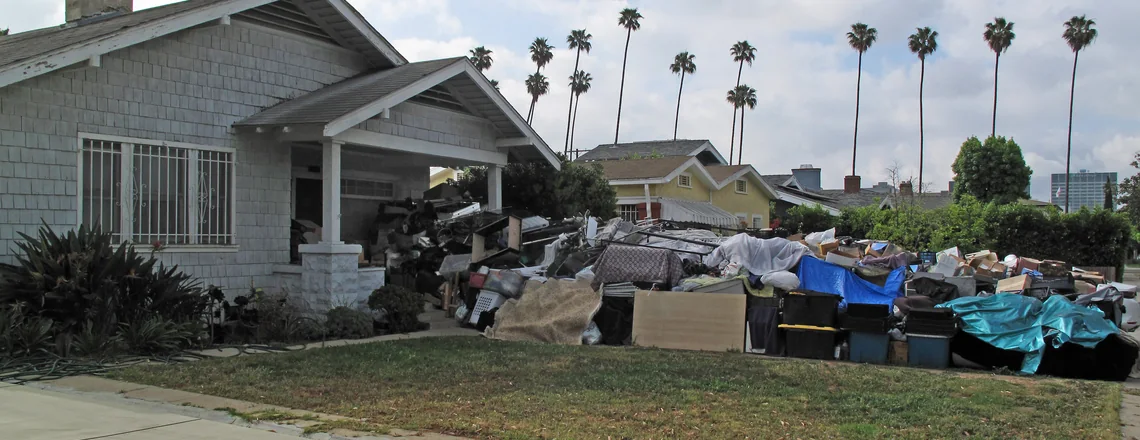
The call usually opens the same way. “The house is full. I mean really full.” Sometimes it is a parent’s house and the family is standing in the driveway working out where to start. Sometimes it is the owner’s own house, and this is a conversation they have been putting off for years. Either way the first question is the same: does all of it have to come out before anybody will buy the place?
No. It does not. Houses sell with the contents still in them every week, and the sale is usually simpler than the cleanout. What the contents do change is who is allowed to buy, what the city can say about the outside, and how much of your own money and time goes in before you get paid. This guide covers all three, plus the short list of things you really should take out first.
Yes, you can sell a hoarder house, and you can sell it full. Three routes are realistic. Clear it out yourself over weeks or months, clean it, then list it to the whole market. Pay a crew to clear it, then list it. Or sell it as-is to a cash buyer who prices the condition and the contents in, and closes on a date you choose without anybody emptying a room first. Which route fits comes down to two numbers only you know: how much cash you want to spend on a house you are leaving, and how many more months you are willing to own it. The route that never works is listing it full on the open market and hoping a financed buyer gets through the front hall.
Here is the part most people have backwards. The clutter itself is not illegal and it does not void a contract. What it does is remove the largest group of buyers from your pool, because almost all of them need a mortgage, and a mortgage brings an appraiser with a rulebook.
Fannie Mae’s Selling Guide B4-1.3-06 grades a property’s condition from C1 down to C6. Properties rated C1 through C5 are eligible “as is”. A C6 means damage or deferred maintenance “severe enough to affect the safety, soundness, or structural integrity” of the house, and a C6 is not eligible for sale to Fannie Mae at all. The deficiencies have to be repaired, and the house has to come back at C5 or better, before the loan can move. The appraiser can write the report “subject to” those repairs, which means your buyer is now waiting on contractors they do not control, in a house they do not own yet.
A packed house runs into that rulebook in a practical way long before anyone argues about letter grades. An appraiser has to identify and describe the condition of the property, and that is hard to do when a room cannot be entered. An inspector cannot read a water heater, a panel or a floor they cannot reach. A buyer’s insurer wants a four point inspection in some states and will ask its own questions. Each of those is a place where a financed deal stalls, and stalling is expensive for you, not for them.
Cash buyers skip every step in that chain, which is the entire reason this kind of house ends up in a cash sale. No lender, no appraiser, no underwriter in week five. If you want the plain version of what “as-is” means in a contract, we wrote it out here: what selling a house as-is actually means.

One chair and a broken table is a curb pile. A full house is measured in tons and truckloads, and the city has a schedule. Photo: City of Greenville, North Carolina, public domain, via Wikimedia Commons (cropped).
We will not hand you a national average, because nobody measured one and the honest answer is that it depends on what is in the house. What we can show you is how the bill gets built, so you can price your own situation instead of guessing.
It comes down to four things: how many truckloads, how much it weighs, how many hours of labor, and what your local landfill charges at the gate. That last number is public. Carroll County, Maryland charges $70 per ton for municipal waste, $75 per ton for bulky waste and $85 per ton for construction debris at its Northern Landfill as of January 1, 2026. Rates differ everywhere, and plenty of counties let residents drop off household trash free, but the shape of the bill is the same: a full house weighs tons, and somebody has to carry it out by hand before it gets weighed.
The common idea is to skip the crew and use city pickup. That works for a garage, not for a house. Houston’s heavy trash rules are a fair sample of how American cities run this. Collection is every other month, six times a calendar year. The limit is 8 cubic yards per set-out, which the city describes as “about the size of a minivan”. Household garbage is never taken. Neither are electronics, nor household hazardous waste such as paint and chemicals. Mix the forbidden items into the pile and the whole pile can be refused and left sitting on your curb.
Do that math on a four bedroom house and the free route takes a year of alternating months, assuming the neighbors stay patient and nothing gets rained on. That is why cleanout crews exist, and why a buyer who includes the cleanout in the deal is worth real money.
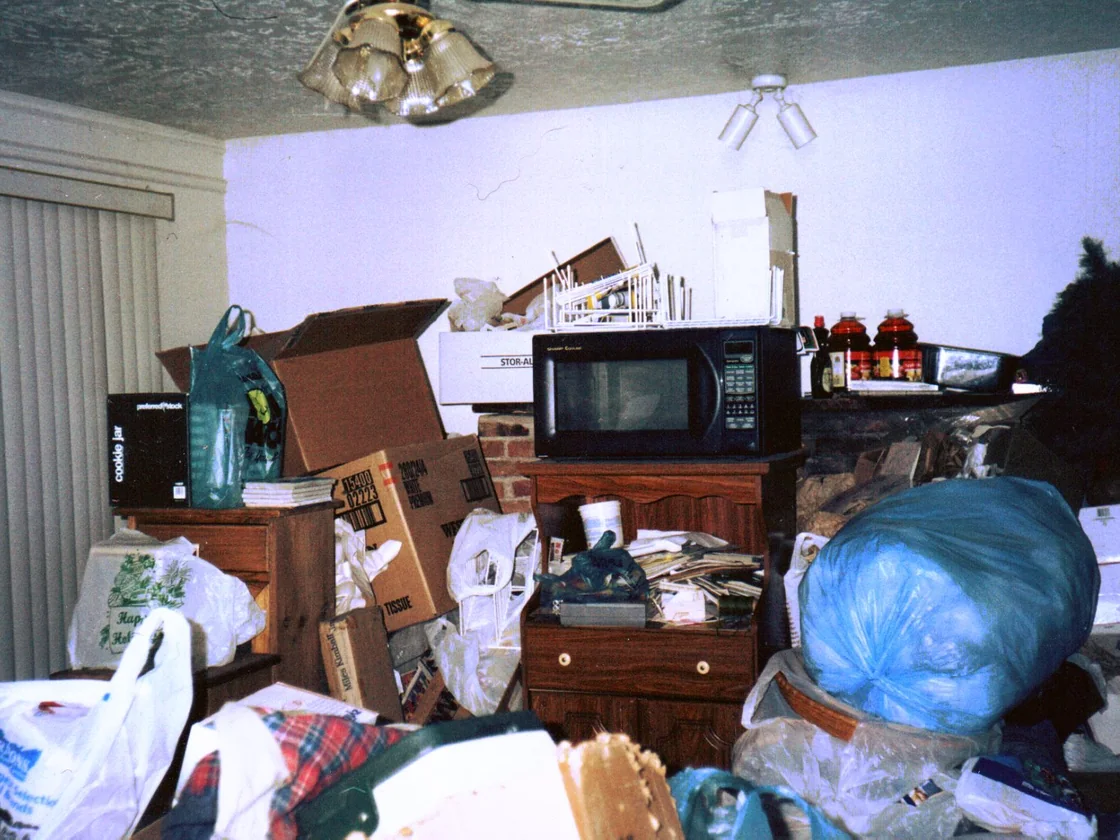
Paper and valuables come out first. Everything else can stay exactly where it is if you sell as-is. Photo: Shadwwulf, CC BY 3.0, via Wikimedia Commons (cropped).
Whatever route you pick, one pass through the house is worth doing before anything else happens. Not a cleaning pass. A retrieval pass.
Take out first: the deed and title paperwork, insurance policies, tax records, bank and brokerage statements, military and medical records, family photos and letters, jewelry, cash tucked into books and coat pockets, medications, and firearms. In a house like this, those things are mixed in with everything else, and they are gone for good once a crew starts loading a truck. Cash and documents are also what a stranger looks for if the house sits open or empty for a while, which is one more reason not to leave it vacant for months: selling a vacant house covers that risk in detail.
Leave, if you are selling as-is: furniture, appliances, clothing, books, boxes, the garage, the shed, the yard. All of it stays. You are not staging anything, and sorting it adds nothing to the price a cash buyer pays.
Do not throw away before you know your route. Tools, appliances, collections, vehicles and anything with resale value are worth more to you than to a landfill. And renting a dumpster before you have an offer in hand can mean spending thousands to raise a price that was not going to move much anyway. Get the number first, then decide what the work is worth.
If you are going the retail route and clearing the house properly, the order that works is: paths first, then floors, then surfaces, then the systems an inspector has to reach, and clean last. Biohazards, meaning animal waste, spoiled food, needles or sewage, belong with a company that handles that specific work, not with a family member and a trash bag.
Before anybody talks about price, there is a set of risks that matter whether or not the house ever sells. Fire departments are blunt about this, because they are the ones who go in. Albuquerque Fire Rescue’s page on hoarding and fire safety lists the problems in order: blocked exits that stop people getting out, items falling on residents, “excessive fire loading that can lead to collapse”, and windows and doorways so obstructed that search and rescue becomes dangerous. It also points out what people forget: in a fire, the neighbors are affected fast too.
The one thing to do this week, whatever you decide about selling: clear a path to every exterior door and keep the furnace, water heater, space heaters, dryer and electrical panel clear of anything that burns.
That costs nothing and it is the difference between a bad day and a funeral. The sale can wait a month. That cannot.
Then there is the city, and the city mostly cares about what it can see. Rock Island, Illinois puts the standard plainly: properties “must be kept free of garbage and junk”, and it lists “junk vehicles, appliances, dilapidated items, or household items found outside” as the examples, with routine inspections across the city plus a complaint line. Every town has some version of that. Notice periods, fines and the city’s right to clean the property and bill the owner vary, so read your own municipal code rather than trusting a number from the internet. If you are already past the warning stage, here is the fuller picture: selling a house with code violations.
One more thing worth saying out loud. Hoarding is a recognized mental health condition, not laziness. The American Psychiatric Association describes it as a persistent difficulty parting with possessions because of a perceived need to save them, puts the overall rate at approximately 2.6% of people, and notes that it is more common after 60 and tends to get more severe with each decade. If the person who lives in the house is still living in it, a cleanout done over their objections is not just cruel, it usually gets undone. That is a conversation for the family and a doctor, and it is not a real estate problem.
Selling as-is does not switch off disclosure. It means you are not promising to repair anything. Those are different things, and sellers get them mixed up all the time.
The rule most states run on was written in one sentence by Florida’s supreme court in Johnson v. Davis, 480 So. 2d 625 (Fla. 1985): where a seller knows of facts materially affecting the value of the property that are not readily observable and are not known to the buyer, the seller has a duty to disclose them. A packed house is a machine for producing exactly those facts. The slow leak behind the stacks, the floor that gives near the back bedroom, the outlet that stopped working two winters ago. If you know it, write it down.
Texas puts the same idea on a form with a deadline. The seller’s disclosure notice in Texas Property Code section 5.008 is based on the seller’s own knowledge and has to be delivered on or before the effective date of a binding contract. The same section lists who is excused from the form, and one of those entries matters here: a transfer “by a fiduciary in the course of the administration of a decedent’s estate”. An executor selling a parent’s house, who never lived there and has no idea what is behind the boxes, is not required to fill in a form full of guesses. Transfers between co-owners and transfers to a spouse or direct bloodline relative are also on that list.
Being excused from a form is not permission to conceal something you actually know. And if the house is coming through an estate, the court timeline usually runs longer than the cleanout does, so start the paperwork early: selling a house in probate walks through who can sign and when.
For a family looking at a full house and a calendar, the honest menu is short: